
Swords and Spears
Swords and Spears
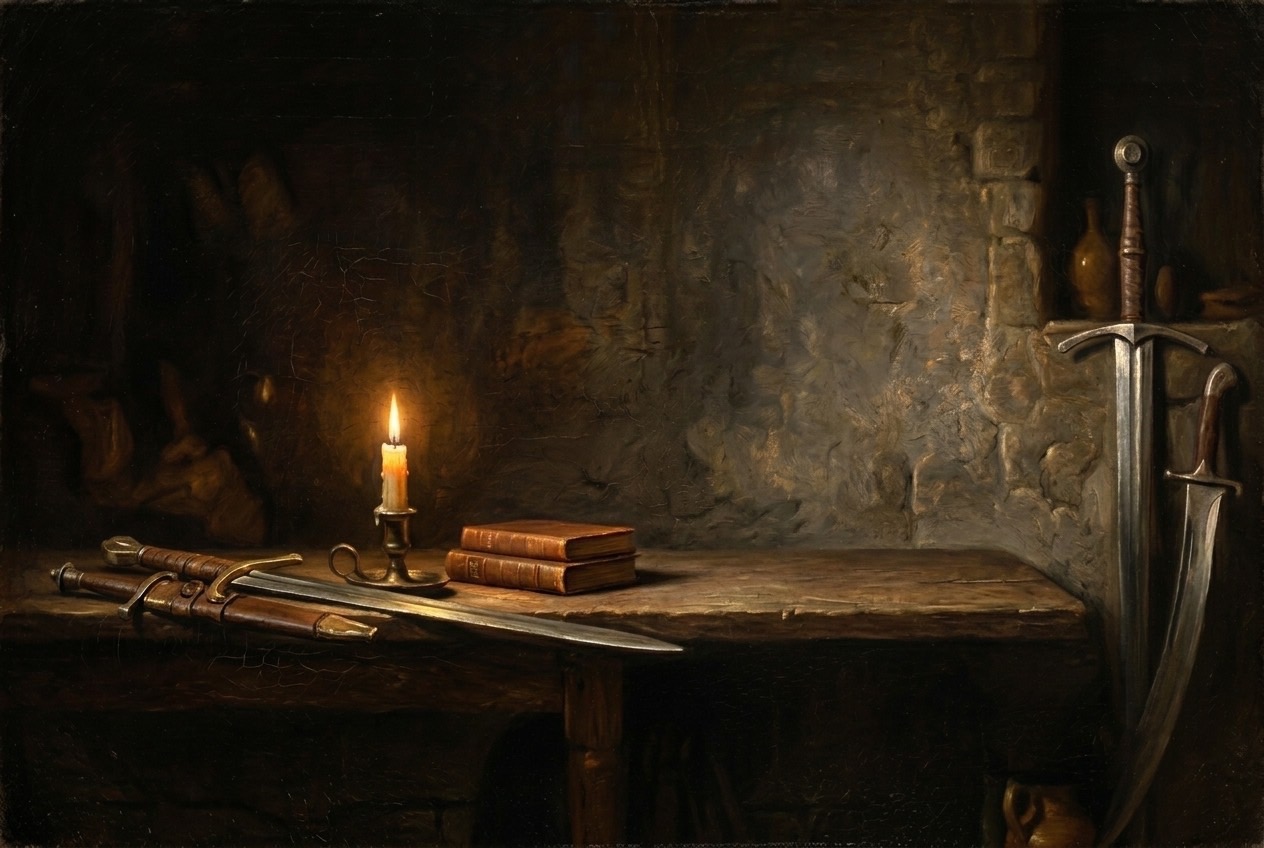
A variety swords were mentioned in the trilogy, but they boiled down to three types. The earliest of these were the gladius, the classic Roman short sword. Later in the Roman Empire the spatha was developed, the longer Roman calvary sword, and that became the standard for both cavalry and infantry in the late Roman Empire. Finally, the trilogy introduced a weapon that was named by Cerdic as soul stealer, a forerunner to the style of swords that became the standard amongst the later Viking invaders that were to arrive in Britannia some three hundred years later.
The reader should understand that the use of swords in medieval times was uncommon. Spears were the weapon of choice, as they were much easier to manufacture, and were easier to learn how to use. These came in two styles. Some spears, such as light weight javelins or the heavier Roman pila, were designed to be thrown, but they had largely fallen out of favor in this period, as other missile type weapons were used. Therefore, instead of swords, the weapon that was ubiquitous on the battlefield was the heavy infantry spear.
Spears were often preferred because of their longer reach, which could allow a warrior to kill an opponent before being reached by a swordsman. The technique of spear use was with quick and precise thrusts. When used with a shield, they were wielded one handed, but they were also used two handed if no shield was available. Many late Roman empire armies emphasized cavalry over infantry, and a shield wall defended by a grounded line of spears was highly e ective in stopping cavalry charges. Horses would not willingly charge into an intact array of spears.
Also, spears were cheaper and easier to manufacture, making them ideal for mass equipped armies with lesser trained soldiers. Iron was scarce, as were blacksmiths properly trained in the manufacture of swords. The Roman short sword, though double edged, was designed primarily for thrusting, and was used almost exclusively with larger rectangular shields, the classic Roman scutum. Its e ectiveness depended on a close order infantry formation and was not very suitable for one-on-one style fighting. Still, the Legions, with their well trained and equipped soldierly, had conquered most of the known world with these techniques.
The spatha was initially designed as a cavalry weapon because of its longer length, but in the later Roman empire it was used by infantry as well. Both the gladius and the spatha had a relatively large ball shaped pommel, made of organic material, like bone or ivory, acting as a counterweight to the longer blade. It was double edged, and the calvary weapon typically had a rounded tip to protect the horse, and to prevent having the sword stick into the ground.
In contrast, the double-edged infantry version had a sharp tip, making it suitable for both thrusting and slashing. These were the forerunner of the swords used in the later Medieval battlefields. The Migration era swords were thinner and not as well balanced as the wider Viking age swords. Over time the metallurgy improved, and the pommel became flatter and more triangle shaped, made of di ering and more decorative materials such as metals.
Though the sword was commonly used as a backup weapon, they were highly prized as a status symbol and were primarily carried by the wealthy. One sword could be worth several cows, and such expense made them rare. They became heirlooms, and amongst the Germanic peoples, would often be given names, to give them a personality and spiritual power. The Norse believed in animism, that the weapon possessed a living spirit, reinforcing the bond between a warrior and his trusted battle companion. This also gave the weapon a sense of history, linking the owner to the renown of his martial ancestors.
Get in touch
-
-
Farmington, Missouri
© Copyright 2026 All Rights Reserved