
The Romano-British Roots of the Real Arthur
The Romano-British Roots of the Real Arthur
So, what do we know about the true historical King Arthur? He was a Romano-Brition, and to fully understand him, one must understand the context of the times in which he lived. Remember that England and Wales were occupied by Rome starting in the first century, and it was controlled by them for over three hundred years.
Initially the Romans did as they did everywhere, finding local leaders to support them and destroying those who were opposed. The occupiers used these local elites to manage local affairs, but in time, just as it happened elsewhere in the empire, the native leaders became more Roman.
Culture was not forced down the Briton’s throats by sword point; rather, Britannia became more “civilized” by gradual assimilation. For instance, Britons were allowed to worship as they pleased, provided they honored the deified emperor. Local gods eventually become fused with Roman ones, whilst newly settled Romans started to worship native deities.
The cultures fused together into the Romano-British. Over time, the natives became used to the Roman way of life, adopting mediterranean culture wholesale, such as wearing toga’s, going to the baths, and even attending gladiatorial games and chariot races. Though still speaking their native Brythonic languages and keeping some aspects of their unique culture, they had become Romanized.
The adoption of Roman culture was the strongest in the southeast, particularly in the legionary garrison towns and in the settlements designated as Colonia, communities established for retired legionaries. In general, the westerners in Wales and Cornwall were less Romanized, and the communities along Hadrian’s wall also maintained a military ethos of the frontier, distinct from the more civilized southeast.
Then the Roman empire collapsed. The legions were recalled to Rome in 410 A.D. Civil war and chaos stalked the land. The wealthy buried their valuables in so-called treasure hordes in these times of turmoil. Many of the owners never returned, perhaps killed in the anarchy, only to be unearthed by modern treasure hunters, while many others immigrated to Brittany. Communications from Britannia was lost to the Mediterranean world for centuries. While the wilder westerners and those along Hadrian’s wall resisted the barbarian incursions relatively well, the more sedentary peoples in the southeast really suffered.
So, who were their raiders? Northeast of Hadrian’s wall were the Picts, a fierce and mysterious people, covered in blue tattoos and a penchant for beheading their enemies for trophies. Pressuring the Picts to move south were the Scotti, an Irish tribe migrating into lands above Hadrian’s wall, and it is from them that Scotland got its name and Gaelic language. The Scotti displacing the Picts were also aggressively raiding Britain’s shores. For instance, Saint Patrick of Ireland was a British noblemen taken in one such raid, enslaved for seven years before escaping.
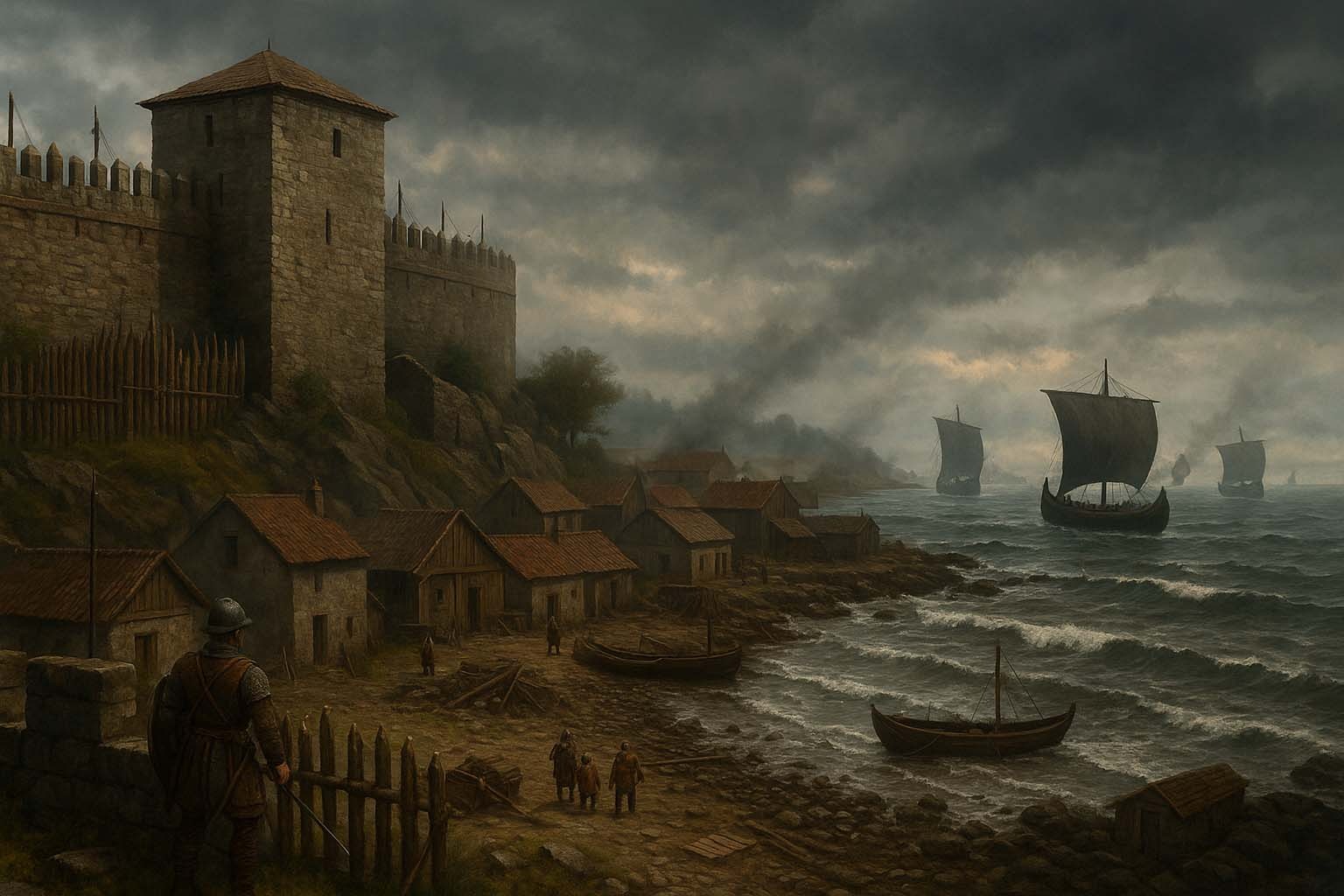
Germanic raiders were an even a bigger problem for the province. During the Roman occupation, the east and south coast of Britannia became fortified by the so-called Saxon shore defenses. This was a series of fortresses constructed from the late second century until the fourth century in response to sea-borne raids by the Saxons and Franks. They were designed to guard coastal cities, provide bases for Roman naval fleets, and to protect important river estuaries. Key forts included, Reculver, Caister-on-sea, Bradwell, Burgh castle, Richborough, Pevensy, and Portchester.
Once the legions left the forts were abandoned, leaving the door open for raiders. Gildas, our best source of information for this period, stated that the Romano-British response was to hire Anglo-Saxons auxiliaries to defend Britannia from these various sets of barbarians. Hiring Germanic mercenaries to fight off other Germanic invaders was a common practice in the late Roman empire, but in this case, it did not work out very well. Thus, the stage was set for someone named Arthur to come to the rescue.
Get in touch
-
-
Farmington, Missouri
© Copyright 2026 All Rights Reserved