
What Britain Really Looked Like in the Wake of Rome’s Collapse
What Britain Really Looked Like in the Wake of Rome’s Collapse
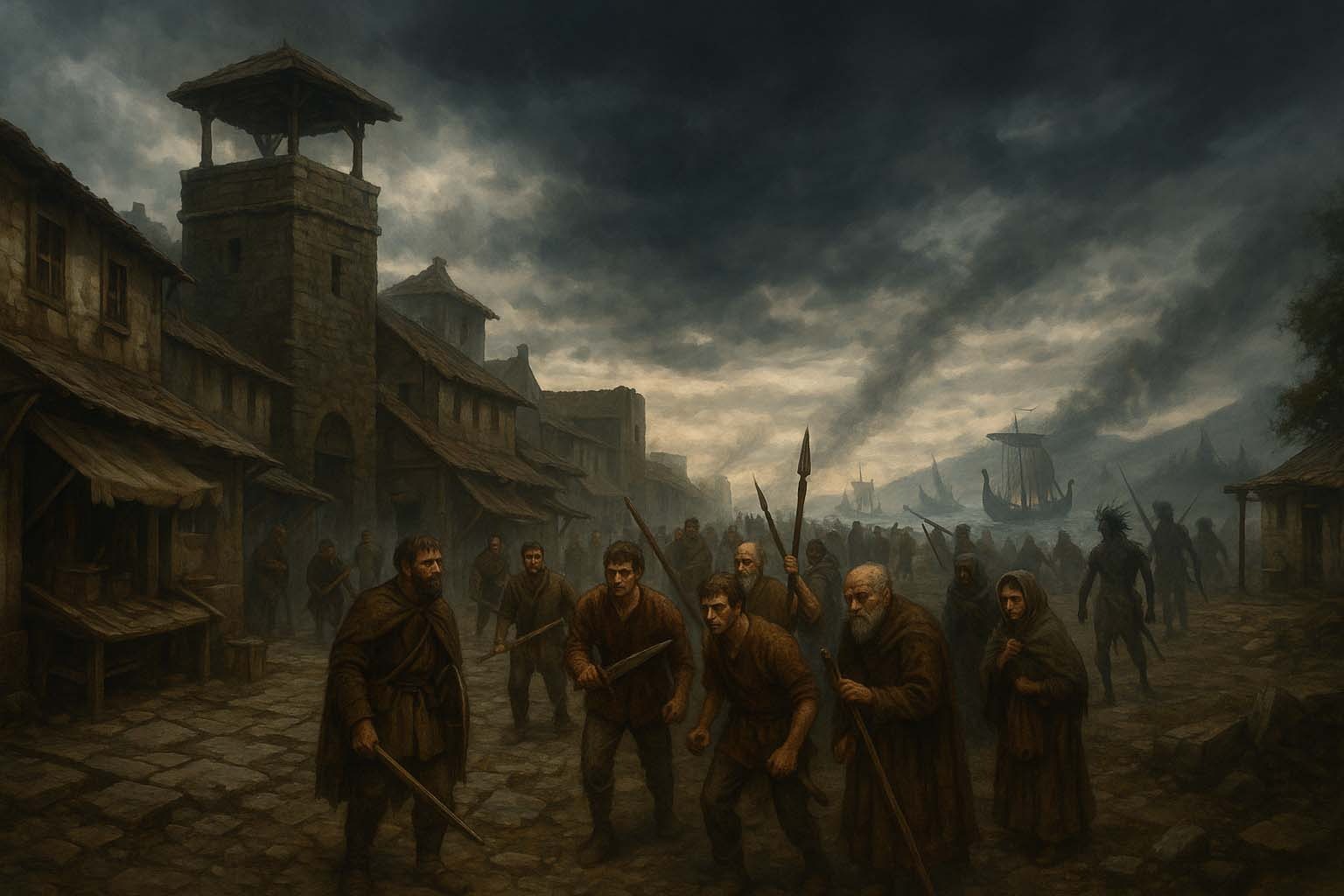
How do you suppose the Britons felt when the legions pulled out? Hadrian’s wall and the Saxon shore forts strung out along the eastern coastline were there for a reason: barbarians were itching to raid the rich lands of Roman Britannia, and Rome was not going to help them. There were hints that many Britons welcomed independence from the empire, but they were a sedentary people, forced to defend themselves from fearsome raiders coming from all directions. They must have been terrified.
Imagine for a moment what would happen to us if the military, police, firemen, and elected governmental leaders all abandoned our country, leaving behind well-armed gangs of drug cartels, the crips and bloods, motorcycle gangs and right-wing extremists. Each community was going to have to organize a militia from scratch. Those with money had already emigrated to the mainland, leaving behind the landless poor and leaderless slaves. The common people had been left to the wolves.
The British in the north and west were able to defend themselves reasonably well as they had retained a martial culture, but in the southeast, these were shopkeepers, farmers and tradesmen, common folk with no military training. Not surprisingly, within a few decades some regions became completely overrun, while others formed alliances with the newcomers, no doubt thinking that having some barbarians on their side would help protect them from the other barbarians.
Evidence for these alliances exist in the archaeological record, as some communities revealed evidence of both Saxon and British burial practices, dwellings, and material goods co-existing at the same time. DNA analysis shows the majority of the of the men were Saxons, as indicated by their y chromosomes, while the women’s DNA were composed primarily natives. The best explanation of this seems to be that many male Britons were killed off.
Other remarkable features of these blended communities were the signs that those people buried in the mid 500’s to late 500’s showed a paucity of material goods and signs of a difficult and short lifespan compared to other generations. The people in the late sixth century, both British and Norse, had a hard time of it.
Their grandchildren became a blend of Norse and British, forerunners of the Anglo-Saxons, able to beat off the Viking invaders that would arrive some three hundred years later. Anglo-Saxon culture was unique to what would become England. Only in Wales, Cornwall, and Cumbria on the western shores of Britain would the Romano-British hang on for a few more centuries.
The reason for this relative poverty, of course, was the cataclysmic events described in book three. The coldest decade on record was followed by the Justinian plague, real events that devastated the world, and not just in Britannia. For instance, The Eastern Roman Emperor was trying to reunite the empire, having reclaimed North Africa, and he had already reconquered half of Italy when the great plague hit. Then his one hundred-thousand-man army was reduced to four thousand, and the effort to reunite the empire died with his army.
It was a devastating demographic collapse. In 400 A.D. Rome had close to a three quarters of a million people, down from a million inhabitants in the previous century. By 500 A.D., it was down to 100.00 thousand. By the time of Charlemagne, some three hundred years later, Rome’s population was a mere twenty thousand. The other largest city in western Europe by that time was Paris with five thousand souls primarily because of the bubonic plague. Epidemics kept reappearing with every new generation before the plague mysteriously disappeared around 800 A.D., not to be seen in Europe again until the mid-1300’s.
It was the darkest of ages for Britannia, yet those perilous times spawned today’s England.
Get in touch
-
-
Farmington, Missouri
© Copyright 2026 All Rights Reserved